The Kidney–Heart Connection
Your kidneys are your heart’s early-warning system. One simple urine test — the uACR — reads a signal that speaks to both, often years before you’d feel a thing.

Why a kidney test can warn you about your heart
Your kidneys are built almost entirely from tiny blood vessels — millions of microscopic filters cleaning your blood around the clock. That makes them one of the best windows in your body onto the health of all your blood vessels — including the ones feeding your heart and brain.
When those filters start to leak a protein called albumin into your urine, it’s an early sign the same kind of damage may be happening near your heart. Doctors call that leak albuminuria.
Here’s the catch: it’s silent. No pain. No symptom. It can show up while your blood pressure looks fine and your EKG looks normal. The only way to know is to measure it.
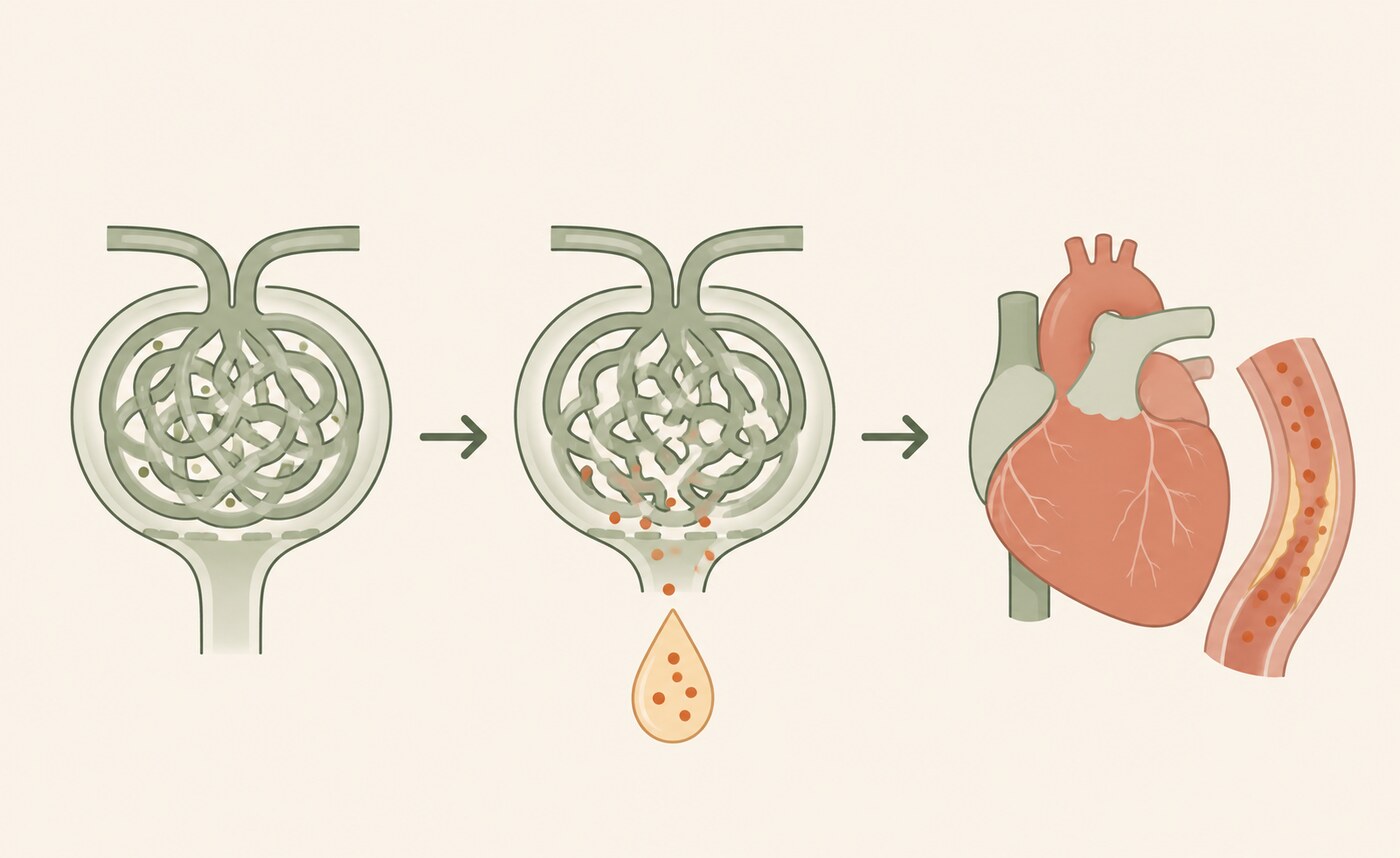
Heart, kidney, and metabolic health are now treated as one system
For years the research pointed one way; now it’s official. The American Heart Association and partner societies (ACC, ADA, ASN) named it cardiovascular-kidney-metabolic (CKM) syndrome — the recognition that heart disease, kidney disease, and metabolic conditions like diabetes are deeply connected.
At the center of spotting it early sit two simple measures: eGFR (a blood test of kidney filtering) and uACR (a urine test for albumin leak). Together they don’t just grade your kidneys — they help predict your risk of heart problems, too.
“Together, eGFR and uACR provide complementary and additive information about the risk of kidney disease, cardiovascular disease, and death.”
In plain terms: your kidneys are your heart’s early-warning system. A normal uACR is reassuring for more than your kidneys. A rising one is an early prompt to act — with your doctor — while there’s still time.
CARDIOVASCULAR · KIDNEY · METABOLIC
One connected system — with uACR as the shared early-warning marker at its center.
What is uACR? One number, two organs’ worth of warning.
Albumin
A protein that belongs in your blood, not your urine. When it shows up in urine, it’s the earliest measurable sign your blood vessels are under strain.
Creatinine
A steady waste product used to correct for how watered-down your urine is — so a glass of water can’t fake a good result. The ratio is what makes the number meaningful, and comparable month to month.
A uACR of 30 mg/g or higher is the line doctors use to flag albuminuria (KDIGO 2024). It’s the same test a lab like Quest or Labcorp runs, using Siemens Healthineers chemistry — Modern Checkup reads it at home with your phone in about a minute.
Who should know their uACR
This matters most for people whose blood vessels are already working harder than they should. Know your number if you:
- Have high blood pressure
- Have type 2 diabetes or prediabetes
- Are over 50
- Have a family history of heart or kidney disease
- Have had a heart scare and want to stay ahead of the next one
- Just want an early-warning number in your corner
Even one of these is reason enough — because albuminuria has no symptoms you can feel.

One reading is a snapshot. The trend is the signal.
A single uACR can be nudged by a hard workout, a fever, or dehydration. What actually matters is the pattern over months. A rising trend tells you far more than any one number — and it’s what lets you and your doctor act early instead of late. That’s the case for checking regularly, not once.
Illustrative example. A single test can look normal while the trend is already rising.
Knowing your number, without the lab trip
Modern Checkup is an at-home uACR test and membership. Same Siemens Healthineers test pads the labs use — you dip a strip, scan it with your phone, and see your result and trend in about a minute. It exists for exactly this: making a test the guidelines recommend easy enough to actually do, and repeat.
It’s a screening and monitoring tool — not a diagnosis. An elevated result is a prompt to confirm with your doctor, and the app makes your history easy to share.
Start Monitoring for $49/moReferences
- KDIGO 2024 Clinical Practice Guideline for the Evaluation and Management of CKD.
- AHA / ACC / ADA / ASN — Cardiovascular-Kidney-Metabolic (CKM) Syndrome Guideline, 2026.
- National Kidney Foundation — kidney disease prevalence & awareness statistics.
- Siemens Healthineers — CLINITEK® Microalbumin 2 product documentation.